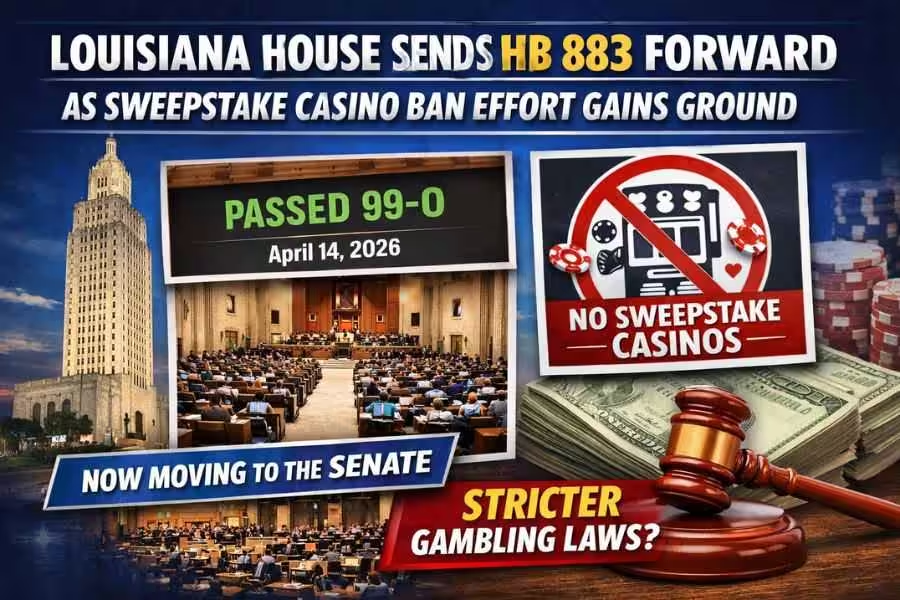

Louisiana lawmakers have taken a new step toward tightening the state’s position on sweepstakes casinos. On April 14, 2026, the Louisiana House passed HB 883 by a 99-0 vote. One day later, the bill was received in the Senate and placed on the calendar for a second reading. That means the proposal is still moving and is now waiting for its next Senate step.
The bill does not use the phrase “sweepstakes casino” much in its core language. Instead, it goes after the dual-currency model many sweepstakes sites use. For a broader look at are sweepstakes casinos legal, it helps to understand why lawmakers are focusing on this structure. Supporters say the bill would give Louisiana clearer rules and stronger enforcement tools. Critics may argue the state already has enough power, especially after last year’s veto fight and later enforcement actions.
What HB 883 Would Change
At the heart of HB 883 is a change to Louisiana’s definition of gambling by computer. The bill says that internet or mobile games that simulate gambling and use a dual-currency payment system would count as illegal online gambling if players can exchange that currency for cash, prizes, cash equivalents, or a chance to win them.
In plain terms, the bill is aimed at the model used by many sweepstakes casinos. These sites often offer one kind of coin for entertainment play and another that can be redeemed under the site’s rules. Louisiana lawmakers appear to be trying to remove any gray area around that structure by writing it directly into state law.
The bill also reaches beyond operators. It would apply to platform providers and merchant payment processors that support or facilitate the activity. That matters because the proposal is not only trying to punish the websites players see. It is also trying to pressure the companies that help those sites stay online and process transactions.
Why This Update Matters
The newest update is important because HB 883 is no longer just a filed proposal. It has now passed the House and moved to the Senate. Before the House floor vote, the bill had already cleared the House Administration of Criminal Justice Committee on April 8 by a 9-0 vote. It then passed the House on April 14 and reached the Senate on April 15.
That is real momentum. The official Louisiana bill page now lists the measure as pending Senate action and scheduled for April 20, 2026. So while the bill is not law yet, it is moving through the process at a meaningful pace.
This also matters because Louisiana has already shown a strong anti-sweepstakes stance. In 2025, a different anti-sweepstakes bill reached Gov. Jeff Landry, but he vetoed it. After that, state officials still kept pushing. Attorney General Liz Murrill later issued an opinion saying sweepstakes casino platforms were illegal under Louisiana law, and the state sent out more than 40 cease-and-desist letters to operators.
HB 883 would build on that history by putting more specific language into statute. In other words, the bill would not create Louisiana’s anti-sweepstakes position from scratch. It would strengthen and formalize it.
What Operators and Players Should Watch Next
The bill’s penalties and enforcement tools are a big reason the industry is paying attention. The reengrossed legislative digest says the measure would raise the maximum fine for offering gambling by computer from $20,000 to $100,000, while keeping the possible prison term at up to five years. It would also create a $20,000 penalty for certain businesses that knowingly support or facilitate illegal online gambling, with doubled financial penalties when the conduct involves someone under 21.
The bill would also let the attorney general send cease-and-desist notices, keep a public list of those notices on the attorney general’s website, and seek court orders to stop illegal online gambling. Recipients would have no more than 10 days after receiving notice to stop the activity. Additional court-order violations involving platform providers or merchant payment processors could trigger fines of $50,000 for a first violation and $100,000 for later violations.
For players, nothing changes right away. The bill still has to clear the Senate and reach the governor. But if it keeps moving, more operators may decide it is safer to leave Louisiana early rather than wait for a final law. For now, the key thing to watch is whether the Senate keeps the bill moving after its next reading.